Blog about things I find interesting, or incredibly stupid.
Mostly its to make fun of other people, post links I find funny and lower the amount of crap I post elsewhere - email me, feel free to comment and please click an ad from time to time!
Mental Floss posted a link to Frank Scherschel's Time-Life collection of rare color photos taken in Europe before and right after the Allied invasion of Normandy beach on June 6, 1944.
I pasted a few below but definitely click the source link to see the whole collection, some of these are really intense.
From LIFE.com: "In rare, color photos taken before and after the invasion, LIFE photographer Frank Scherschel captured countless other, lesser-known scenes from the run-up to the onslaught and the heady weeks after: American troops training in small English towns; the French countryside, implausibly lush after the spectral landscape of the beachheads; the reception GIs enjoyed en route to the capital; the liberation of Paris."
An abandoned German machine gun, France, June 1944
An American tank crew takes a breather on the way through the town of Avranches, Normandy, summer 1944
View of the ruins of the Palais de Justice in the town of St. Lo, France, summer 1944. The red metal frame in the foreground is what's left of an obliterated fire engine
From D-Day until Christmas 1944, German prisoners of war were shipped off to American detention facilities at a rate of 30,000 per month. Above: Captured German troops, June 1944
American Army trucks (note cyclist hitching a ride) parade down the Champs-Elysées the day after the liberation of Paris by French and Allied troops, August 1944
"Paris is like a magic sword in a fairy tale — a shining power in those hands to which it rightly belongs, in other hands tinsel and lead. Whenever the City of Light changes hands, Western Civilization shifts its political balance. So it has been for seven centuries; so it was in 1940; so it was last week." — LIFE after the French capital was liberated in August 1944
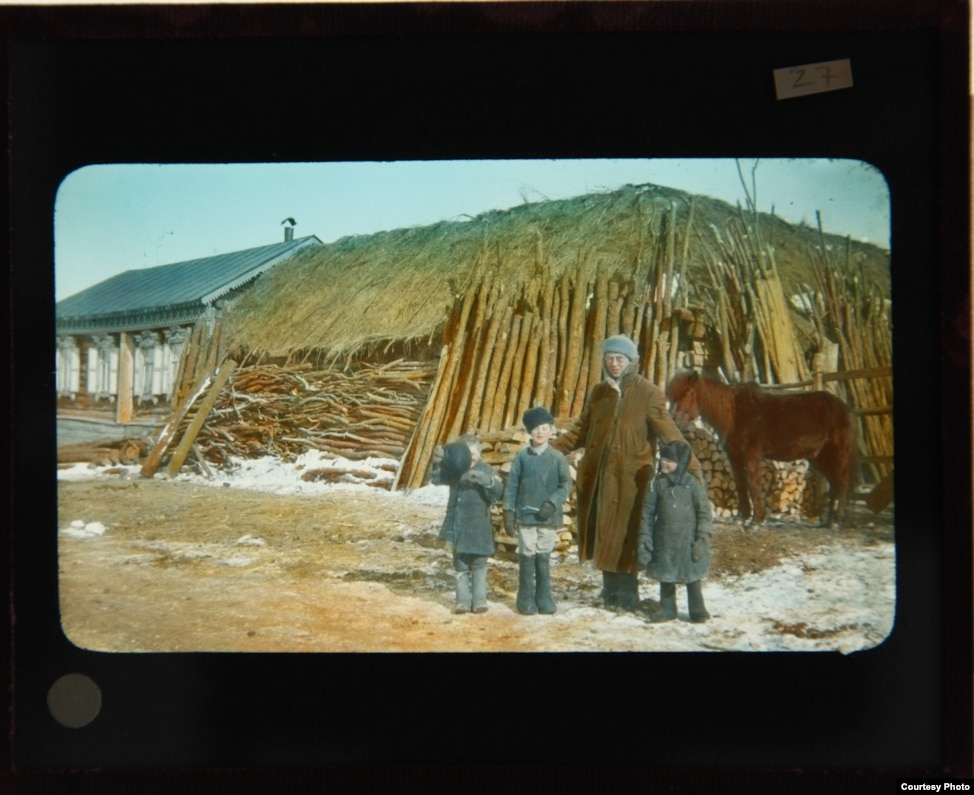
This is really cool. Back in 1917, American photographer pastor John Wells Rahill took these shots during the Russian Revolution*. The problem was soon after (in the '20s) anybody who had been to Russia were seen as Socialist sympathizers. To avoid this, he packed the photos (now on glass plates) away where they sat until 2005...
From the Mental Floss synopsis: The slides capture everything from soldiers wearing gas masks near bunkers to ruined buildings in Moscow. Orlov told Radio Free Europe/Radio Liberty that the slides "were hand-colored by what must have been one of the very best photo-finishing businesses in the U.S. I am still hoping to find out who did such a wonderful job with them." [In addition] the collection also features images that Rahill snapped as he was evacuated from Russia through China and Japan.
Check out the source link(s) below.
*Short version: The Russian Revolution was when the Bolshevicks (later more commonly referred to as Communists) took over the country from the former Imperialist Royals/government, ending the reign (and lives**) of the Romanov family led by Nicholas II.
At the end of World War II (coincidentally during the height of production) surplus items were destroyed in BULK (I'm literally crying typing this thinking of all the ArmyJeeps not in my driveway) in order to control [black] market pricing...
From i09:
Soon after WW2, much of the material was written off at the time it
was accepted; if too much of it got into the hands of traders (the
Chinese excelled at this), it could depress the market for new goods.
And in fact, the West did experience several challenging years until
their manufacturing capacity was reconverted to the manufacture of
peacetime goods. To cope with this, many Allied countries had to
get rid of their surplus equipment. It got so bad that, in some cases,
the excess equipment was disposed of by burning, including aircraft. In
one account, an entire pier was constructed entirely of new jeeps still
in their packing cases.
But according to the recollections of some U.S. veterans, an entire
squadron's worth of Mark XIV Spitfires were buried in various parts of
Burma — about 140 fighters to be exact. And according to one source,
there may be as many as 36 buried close to the runway at the Rangoon
airport. Unfortunately, the initial search has turned up short. A team of 21 archaeologists had spent the last few days digging up
various holes around the Rangoon airport looking for the giant crates.
But all they found were bundles of electric cables and water pipes. According
to the archaeologists, they haven't stopped searching, and "cannot
stop" now. They consider it a setback and a delay in their work.
What a great story. Short version: 4 days before Christmas in 1943, a German fighter pilot safely escorted a heavily damaged American bomber to safety during WWII because "He was a veteran pilot with an iron sense of right and wrong; a man who would never kick another while he's down."
Longer version (quoted from Jalopnik's post): (click the link below for the full story): 2nd Lieutenant Charlie Brown's B17 bomber, [named] Ye Old Pub, approached Bremen, Germany. As German anti-aircraft batteries opened up on the formation, one of the anti-aircraft rounds exploded right in front of their plane, destroying the number two engine and damaging number four. Missing one engine and with another throttled back due to damage, Ye Olde Pub could no longer keep up with the formation. Things went from bad to worse for Brown and his crew. Falling behind the formation, Ye Olde Pub weathered merciless attacks from 15 German fighters. The bomber's machine guns got one of them, but the damage they sustained was immense. The tail gunner was killed and four were injured, including Brown, who caught a bullet fragment in his right shoulder. The only defensive guns left in service were the top turret and the nose gun, and the bomber's hydraulics and oxygen systems had also been knocked out. As Ye Olde Pub attempted to leave German airspace, Lt. Franz Stigler, a Luftwaffe fighter pilot just in from shooting down two B-17s, saw Ye Olde Pub limp by and gave chase. I saw his gunner lying in the back profusely bleeding….. so, I couldn't shoot. I tried to get him to land in Germany and he didn't react at all. So, I figured, well, turn him to Sweden, because his airplane was so shot up; 'I never saw anything flying so shot up'.
He tried to contact Brown with hand signals. His message was simple: Land your plane in Germany and surrender or fly to Sweden. That heap will never make it back to England.
A bewildered Brown stared back through his side window, not believing what he was seeing. He had already counted himself as a casualty numerous times. But this strange German pilot kept gesturing at him. There was no way he was going to land the plane, but the pilot stayed with him, keeping other attackers off until they reached the North Sea.
[Their story was buried in their memories (and archives in the case of Brown) due to the mission's sensitive nature and the fact that Sigler would've been court marshaled for not attacking.]
[Years later,]in 1986, then retired Colonel Charlie Brown was asked to speak at a big combat pilot reunion event called Gathering of the Eagles. Someone asked him if he had any memorable missions during World War II. Brown thought a minute, then dredged up the story of Stigler's salute which had been buried somewhere in the dirty corners of his mind for decades. Jaws dropped. Brown knew he would have to try to find the man who had spared his life.
[Brown searched for 4 years to find the pilot that had spared his life without much luck.] So he wrote a letter in a combat pilot association newsletter.A few months later, Brown received a letter from Canada. It was from Stigler. "I was the one," it said. When they spoke on the phone, Stigler described his plane, the salute; everything Brown needed to hear to know it wasn't a hoax.
From 1990 to 2008, Charlie Brown and Franz Stigler became like brothers. Introduced by the bond of that first powerful meeting, their friendship was cemented over the years. The two men remained close throughout the rest of their lives, dying within several months of each other in 2008.
What if Stigler had been executed for his disloyalty? What if Brown had landed in Germanyor hadn't made it across the North Sea? What if Stigler had stayed in Germany and never learned how to speak English? Yes, things could have been different, but that chance encounter in 1943 was destined to become a chance encounter again in 1990. But more importantly, it's proof to the rest of us that something great done now can change your life much, much later.